Overview
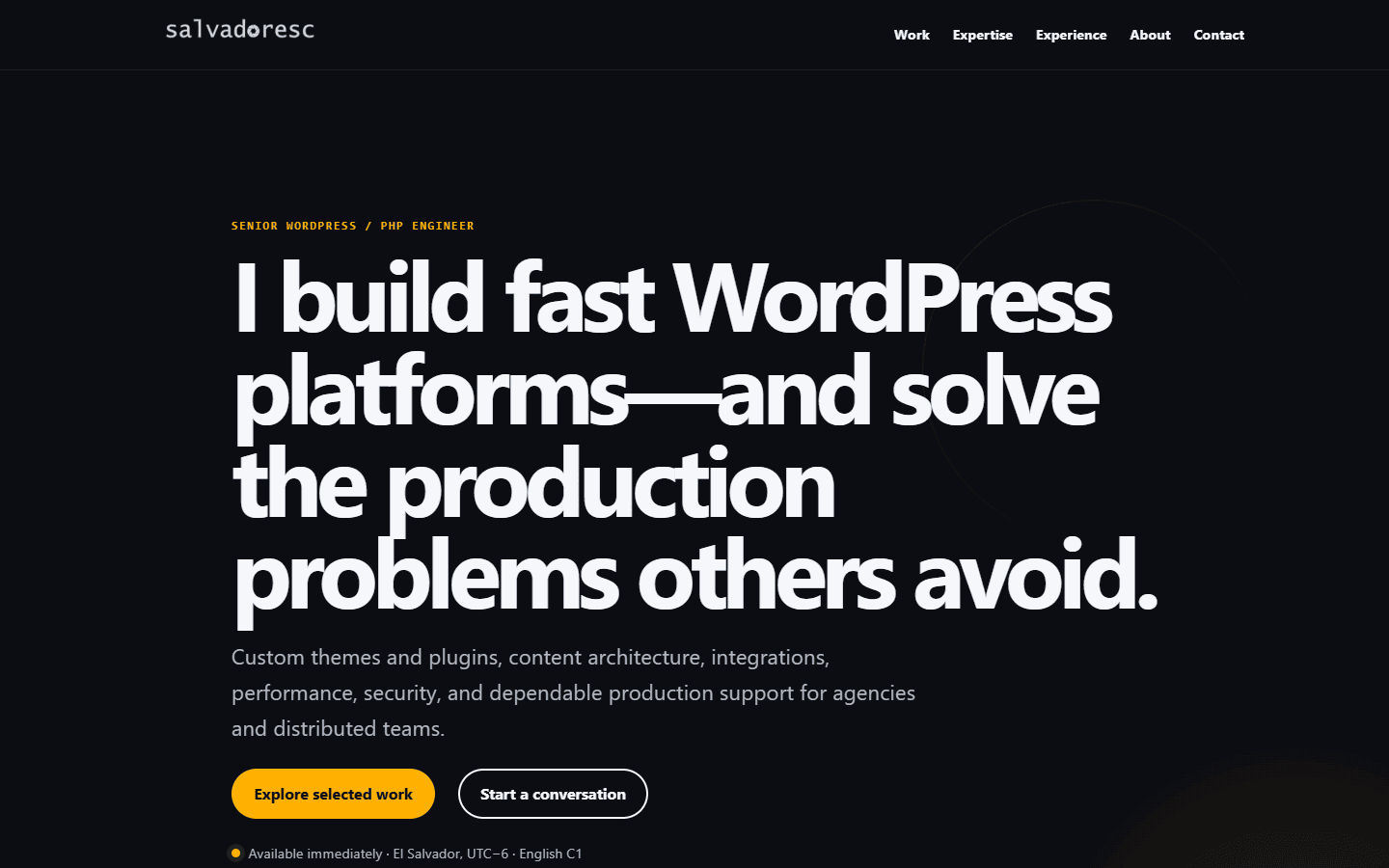
Salvadoresc.com is my personal portfolio and a practical demonstration of how I approach WordPress engineering: preserve editorial usability while reducing frontend complexity, remove unnecessary dependencies, and treat performance and accessibility as product requirements.
The site was rebuilt from a Divi-based implementation into a custom block theme supported by a focused content plugin. WordPress remains the publishing platform, while the public experience is lightweight, responsive, accessible, and fast enough to feel like a single-page application.
The challenge
The previous implementation contained valuable project content, featured images, galleries, and years of existing WordPress data. Rebuilding the site could not mean discarding that content or coupling it to another page builder.
The new implementation needed to:
- Preserve and migrate eight existing Divi projects safely.
- Keep projects and certifications editable in WordPress.
- Support Gravity Forms without exposing an email address publicly.
- Provide fast navigation between portfolio pages.
- Remain compatible with standard WordPress URLs, server rendering, and search engines.
- Reach excellent performance and accessibility scores without sacrificing visual polish.
Content architecture
I developed a companion WordPress plugin that owns the content model independently from the active theme. It registers Projects, Certifications, their taxonomies, and REST-enabled metadata for project URLs, roles, dates, technology stacks, results, credentials, and galleries.
A migration utility converted the original Divi project content into native WordPress content while retaining a backup of the original builder markup. This allowed the frontend to move away from Divi without losing the ability to recover or audit the previous data.
The plugin also provides dynamic blocks for the portfolio grid, project facts, galleries, certifications, related projects, the contact form, and the client-navigation region.
Fast navigation without abandoning WordPress
The site uses the WordPress Interactivity API and its router to prefetch eligible internal links and update the primary content region without a full document reload. Browser history, canonical URLs, direct visits, and normal server-rendered responses continue to work.
If client-side navigation is unavailable, every link falls back to a standard WordPress request. This progressive-enhancement approach provides SPA-like speed without introducing a separate frontend application or duplicating the WordPress content model.
Performance and accessibility work
The optimization process included removing unused Divi carousel assets, limiting AdSense to editorial blog contexts, disabling unnecessary third-party login code, using native lazy loading, serving modern image formats, and keeping the theme JavaScript intentionally small.
Animations respect reduced-motion preferences and are scoped so that they do not compromise form contrast. Gravity Forms remains fully functional while its public presentation is controlled by the theme.
During testing, Lighthouse exposed a subtle accessibility issue caused by a cached stylesheet retaining an older opacity animation. The problem was diagnosed by inspecting computed styles in Chrome, isolating the stale asset, and deploying a versioned stylesheet filename to guarantee cache invalidation.
Measured results
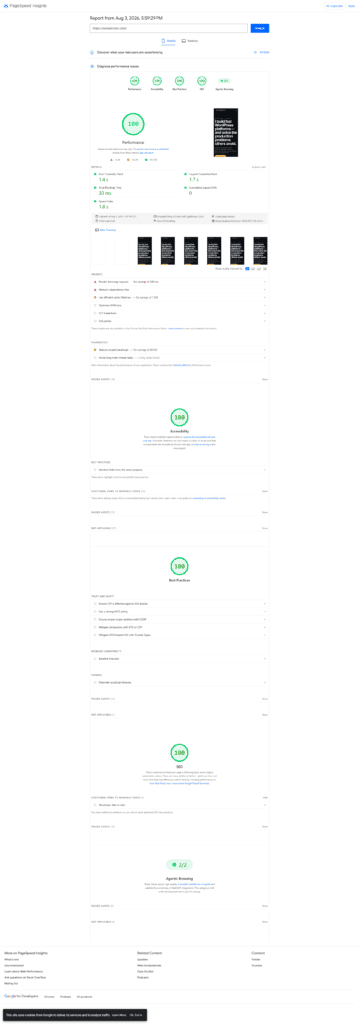
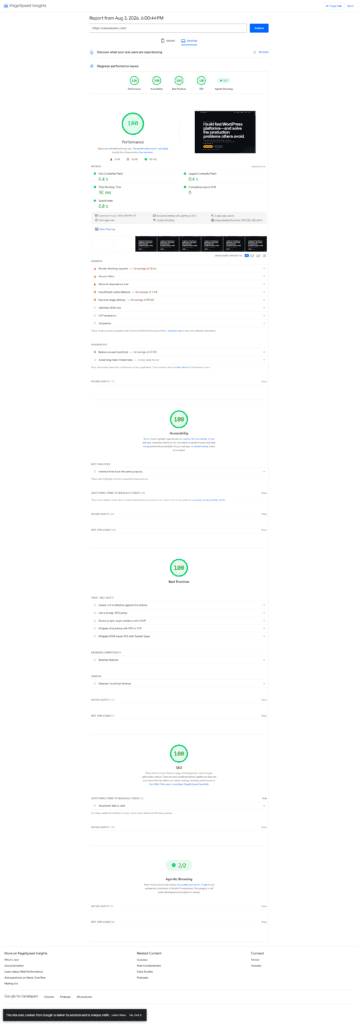
Google PageSpeed Insights lab audit recorded on August 3, 2026:
Mobile
- Performance: 100
- Accessibility: 100
- Best Practices: 100
- SEO: 100
- First Contentful Paint: 1.4 s
- Largest Contentful Paint: 1.7 s
- Total Blocking Time: 30 ms
- Cumulative Layout Shift: 0
- Speed Index: 1.8 s
Desktop
- Performance: 100
- Accessibility: 100
- Best Practices: 100
- SEO: 100
- First Contentful Paint: 0.4 s
- Largest Contentful Paint: 0.4 s
- Total Blocking Time: 30 ms
- Cumulative Layout Shift: 0
- Speed Index: 0.8 s
Outcome
The result is a maintainable WordPress portfolio that demonstrates the same qualities I deliver for production work: thoughtful content architecture, safe migrations, progressive enhancement, accessible interaction, and performance validated with measurable results.