When I Was Considered Overqualified for an Adobe Exam Beta
Recently, I saw someone asking for a developer with Dreamweaver experience.
I had not heard the application mentioned in a long time. It immediately brought back memories of an earlier stage of my career, when Dreamweaver was one of the central tools in professional web production and I used it extensively enough to become certified and teach Adobe technologies.
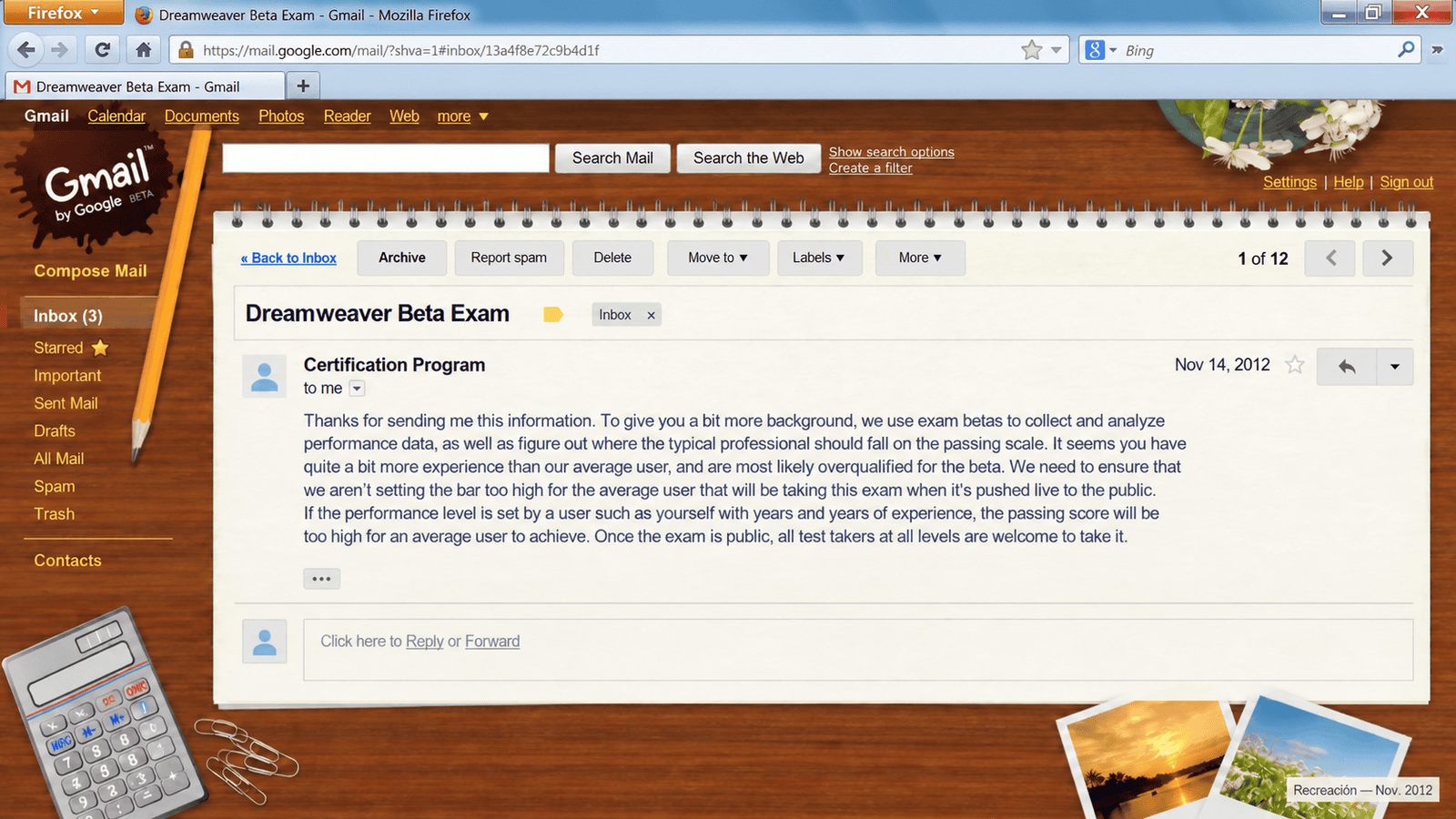
The memory made me search through my old email. I did not find the original message I was looking for, but I found something nearly as useful: a copy I had pasted into a Gmail chat on November 21, 2012.
It came from a conversation about participating in the beta of an Adobe certification exam.
Thanks for sending me this information. To give you a bit more background, we use exam betas to collect and analyze performance data, as well as figure out where the typical professional should fall on the passing scale. It seems you have quite a bit more experience than our average user, and are most likely overqualified for the beta. We need to ensure that we aren’t setting the bar too high for the average user that will be taking this exam when it’s pushed live to the public. If the performance level is set by a user such as yourself with years and years of experience, the passing score will be too high for an average user to achieve. Once the exam is public, all test takers at all levels are welcome to take it.
Why certification exams have betas


An exam beta is not simply an early version offered to a random group of users. The organizers need performance data from people who represent the professionals expected to take the final exam.
Their results help determine whether questions are appropriately difficult and where the passing standard should be placed. The group therefore needs to reflect a realistic range of professional experience.
After I shared my background, the response explained that I appeared to have considerably more experience than their average user and was “most likely overqualified for the beta.” Including someone with years of advanced experience could contribute to setting the bar too high for the typical professional taking the public exam.
It was a rejection—but probably the most flattering rejection I have received.
What that message represented
By that point, Dreamweaver was not simply an application I occasionally opened. It was part of a broader working environment that included HTML, CSS, JavaScript, visual production, browser compatibility, reusable templates, and the practical realities of maintaining websites for organizations and clients.
I had also become an Adobe Certified Instructor, later holding the Web Specialist and Design Master credentials. Teaching added another dimension to technical proficiency: it was not enough to know which button to press. I needed to understand the underlying concepts well enough to explain them, identify mistakes, and help other people work independently.
That distinction still matters. Familiarity with a tool is not the same as understanding the system behind it.
Dreamweaver was a tool, not the destination
Dreamweaver is no longer part of my everyday workflow. Modern web development has moved through many different editors, frameworks, build systems, content models, deployment workflows, and collaboration tools.
My own work evolved from handcrafted websites and Adobe tooling into enterprise frontend systems, PHP, custom WordPress themes and plugins, Advanced Custom Fields, Gutenberg, React, API integrations, performance engineering, accessibility, Git-based workflows, and AI-assisted development.
The transition did not erase the earlier experience. It built on it.
The browser still interprets HTML, CSS, and JavaScript. Interfaces still need to adapt to different screens. Content still needs structure. Editors still need usable systems. Production releases still require care. Clients and team members still need technical decisions explained in language they can act on.
Even some of the habits associated with older visual tools remain valuable when applied with judgment: noticing alignment, understanding typography, organizing reusable components, and seeing the relationship between the editing experience and the final output.
The durable part of expertise
Looking back at that 2012 message reminded me that a long career in technology is not defined by using the same tools forever.
It is defined by learning tools deeply enough to understand their strengths and limitations, retaining the principles beneath them, and continuing to adapt when the industry changes.
Today I would not recommend starting a new WordPress project in Dreamweaver. I would define the content architecture, choose the appropriate WordPress APIs, build maintainable themes or plugins, establish a practical Git workflow, and account for performance, accessibility, security, and the editing experience from the beginning.
But the curiosity and attention to detail that led me to master Dreamweaver are the same qualities I bring to that work now.
The tools changed. The standard did not.