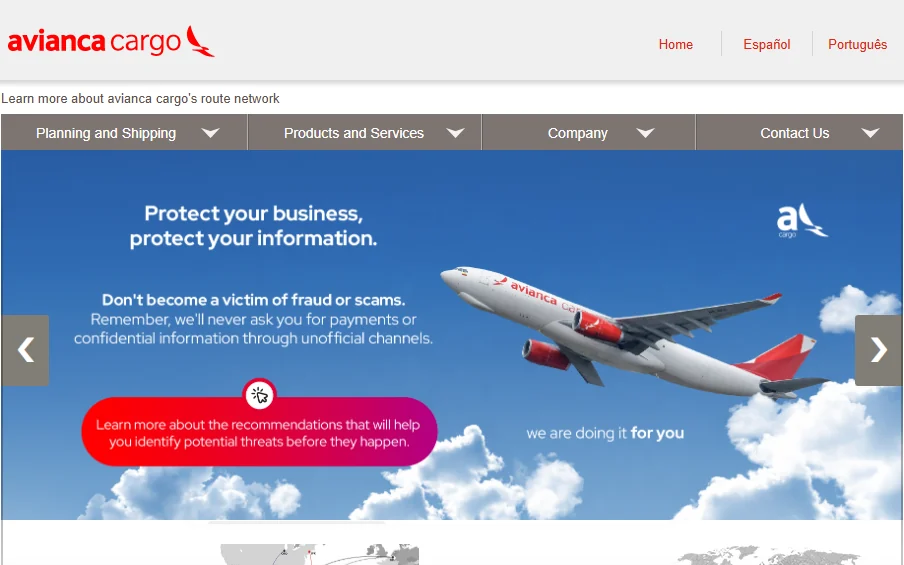
During my time at Avianca, I contributed to a group of enterprise frontend initiatives for Avianca Cargo. The work supported the consolidation of several cargo operations under a unified digital experience and included a multilingual corporate website, an interactive aircraft microsite, and an emergency-response dark site.
My role combined hands-on frontend development with ownership of the shared layout architecture. I built and maintained reusable structures, implemented much of the page-level frontend, and enabled other developers to add content while preserving a consistent interface across a large multilingual platform.
Unifying multiple cargo brands
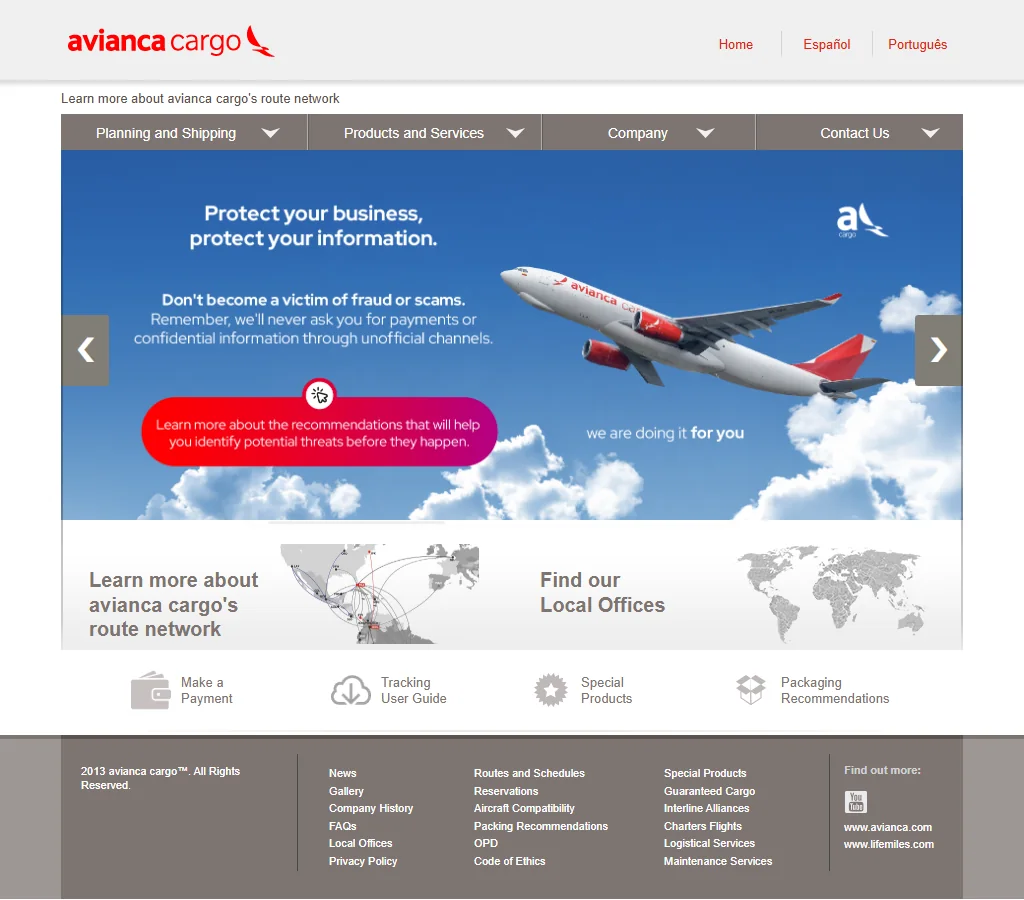
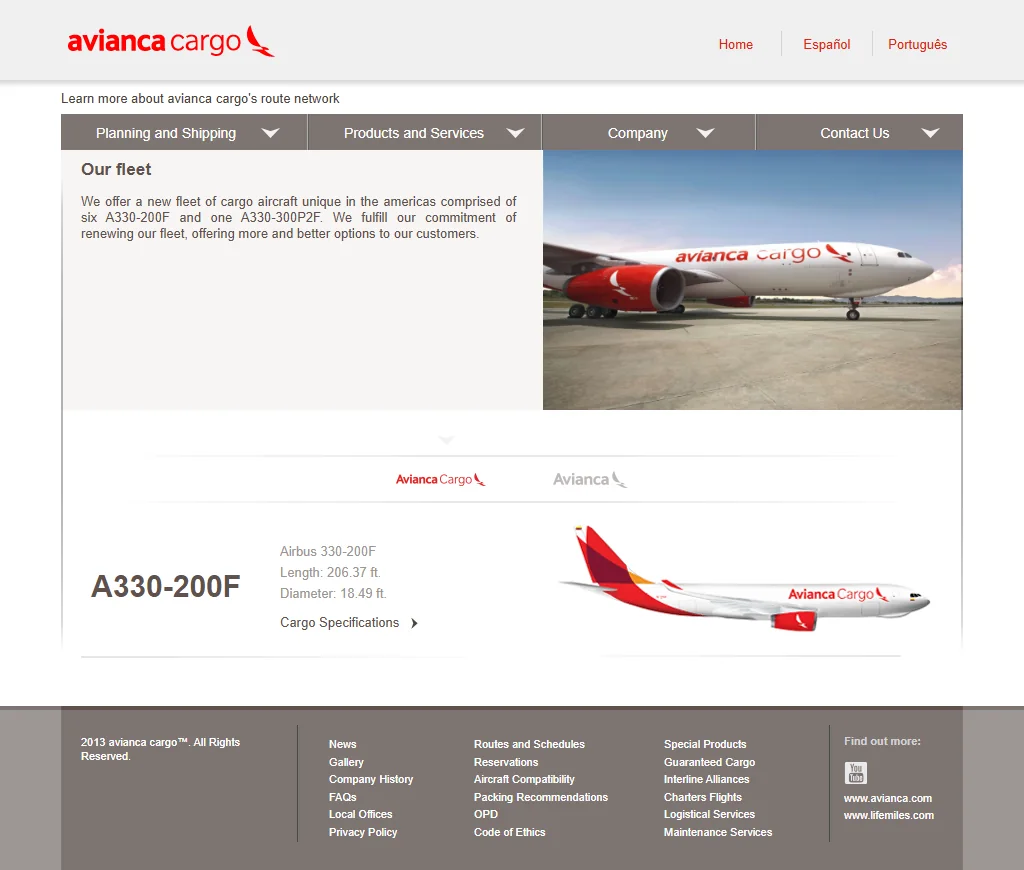
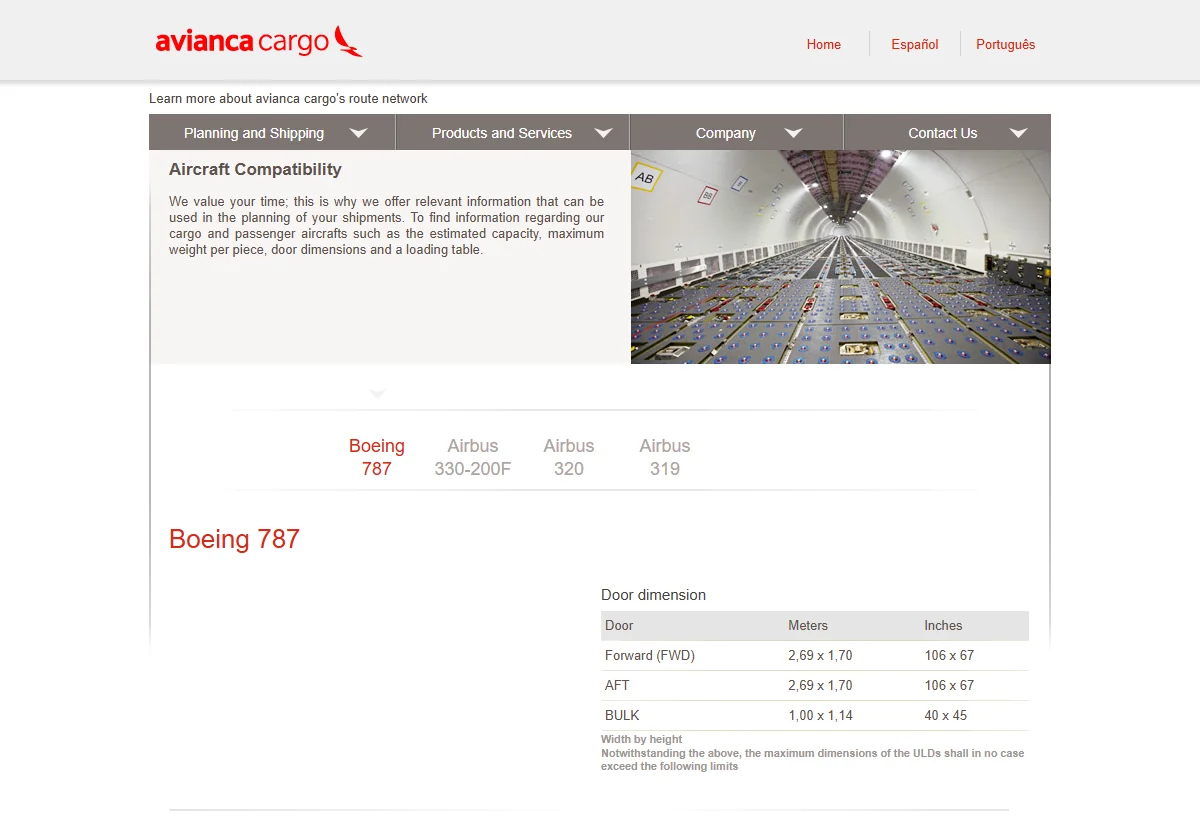
The primary Avianca Cargo website was created while the cargo operations associated with Avianca, TACA Cargo, and Tampa Cargo were being brought together. The platform needed to present one coherent brand while accommodating services, operational tools, fleet information, galleries, offices, packaging guidance, and the history of the participating airlines.
The application was built with ASP.NET Web Forms and reusable Master Pages. Shared elements such as the header, footer, navigation, and layout structure were maintained centrally, allowing a multi-developer team to create and update pages without rebuilding the surrounding interface each time.
I was responsible for the general frontend layout and produced many of the pages that formed the site. This structure reduced duplication, improved consistency, and made it practical for several contributors to work within the same platform.
A custom multilingual system
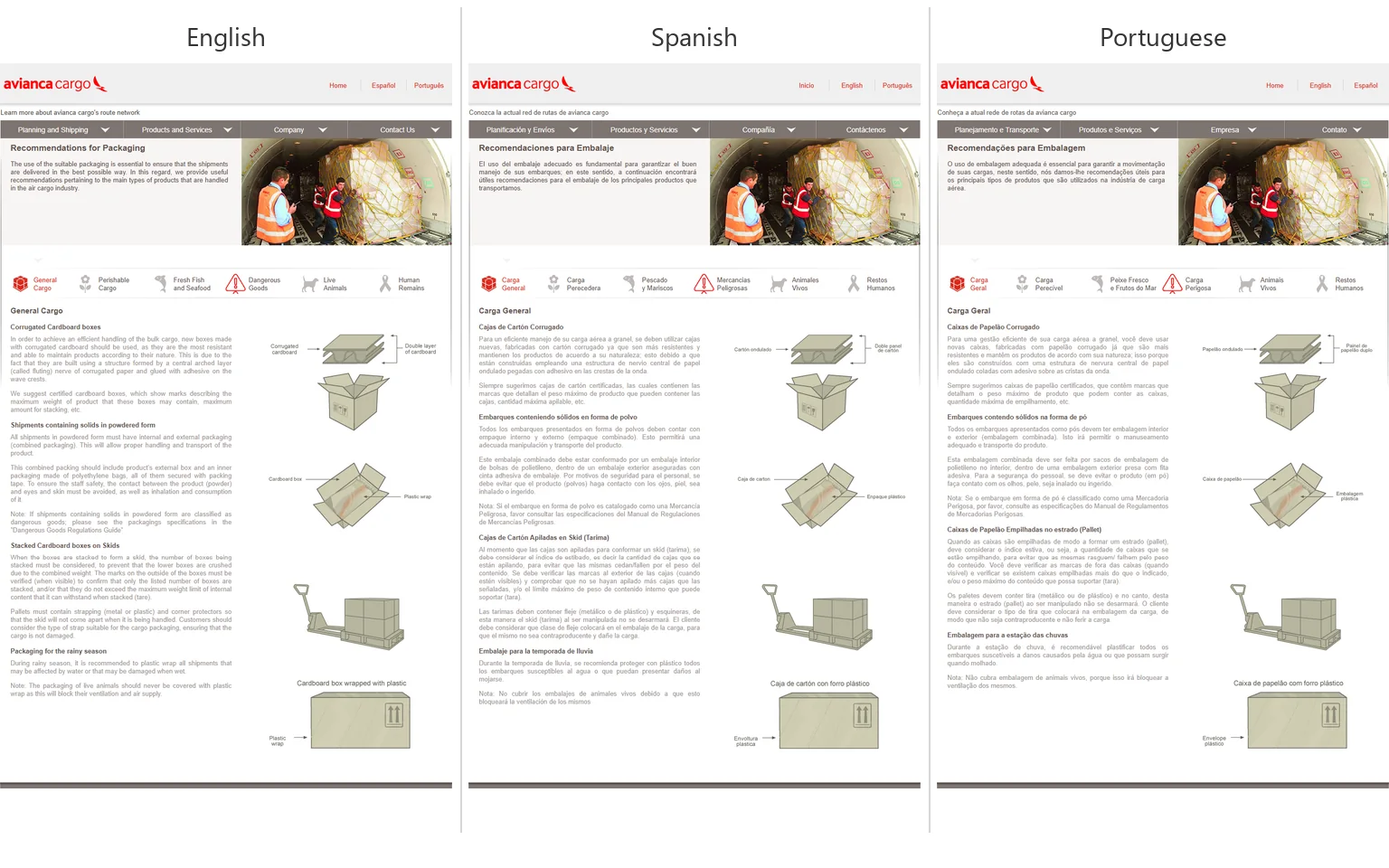
The corporate platform and A330 microsite were delivered in English, Spanish, and Portuguese. I implemented a lightweight language-selection system suited to an international organization whose employees and users regularly shared links across countries.
The system remembered the visitor’s language preference in a cookie. If someone who had selected Spanish received a link pointing to an English path, the experience could preserve the visitor’s chosen language instead of forcing the language encoded in the shared URL. This created continuity across sessions and reduced friction when links moved between multilingual teams.
The language directories followed a predictable structure, while Master Pages and reusable components kept the three experiences aligned. This made the system easier to extend and reduced the amount of repeated layout work required for localized pages.
Interactive A330-200F microsite
A dedicated microsite was created to introduce the new Airbus A330-200F aircraft acquired for cargo operations. It presented aircraft specifications, configurations, dimensions, imagery, and an interactive aircraft viewer.
The viewer simulated a three-dimensional rotation by displaying a sequence of aircraft images in response to user input. JavaScript translated the visitor’s controls into movement through the image sequence, producing an interactive 360-degree experience without requiring a WebGL model or specialized browser plug-in like Adobe Flash.
The microsite was also available in English, Spanish, and Portuguese and used the same language-preference principles as the primary platform.
Emergency-response dark site
The third deliverable was an emergency-response dark site designed specifically for activation following an aviation incident. It was deployed and kept ready but, fortunately, has not needed to be used for an actual emergency.
The technical design was shaped by an important enterprise constraint. Publishing application changes at Avianca required a formal change-control process that included reviews and committee approval. That governance was appropriate for normal production work, but the full process could take days or weeks—an unacceptable delay when verified information might need to be published immediately during an emergency. A conventional CMS was not available, and the project did not have the resources to purchase or develop one.
I designed the application so that its code could remain stable and fully governed while emergency content followed an existing, approved operational path. The experience was built with HTML, CSS, JavaScript, and AngularJS, and the latest information was read from plain-text files. Authorized teams were permitted to update and upload those content files without initiating a new application deployment or modifying the underlying code.
AngularJS transformed the uploaded information into navigable views across the site’s three supported languages. This separated presentation logic from time-sensitive content and gave the organization an immediate publishing capability without weakening the change controls protecting the application itself.
The project required a different kind of engineering judgment: the interface had to remain simple, predictable, and ready to communicate clearly under exceptional circumstances. Its success was readiness rather than traffic. The dark site remained available for activation, and fortunately no aviation tragedy required its use during that period.
Preserving a long-lived project
The Avianca Cargo platform remained online and usable years after its original delivery. Although parts of the design and implementation reflect the standards of their era, much of the structure continued serving real content long after I left the organization.
Because enterprise websites can eventually be redesigned or retired, I later used Python to create a static archival copy of the experience. The objective was not to replace the official website, but to preserve a demonstrable record of work that could otherwise disappear, as happened with other large projects from the same period.
Key contributions
- Owned and maintained shared frontend layout architecture for an enterprise platform.
- Built reusable ASP.NET Master Page structures for consistent multi-page delivery.
- Developed much of the page-level frontend while supporting contributions from other developers.
- Implemented a custom three-language preference system using persistent browser state.
- Helped unify multiple cargo brands and operational resources in one digital experience.
- Built an image-sequence-based interactive aircraft viewer with JavaScript.
- Designed an AngularJS dark site that separated governed application code from immediately publishable emergency content.
- Created Python-based archival tooling to preserve a long-lived example of the work.
Technologies
HTML, CSS, JavaScript, AngularJS, ASP.NET Web Forms, Master Pages, jQuery, browser cookies, multilingual frontend architecture, and Python.
Explore the official experiences
Corporate platform:
https://www.aviancacargo.com/index.aspx
A330-200F microsite:
https://www.aviancacargo.com/eng/330/main.aspx
Emergency-response dark site:
https://www.aviancacargo.com/darksite/index.html#/detalles-vuelo